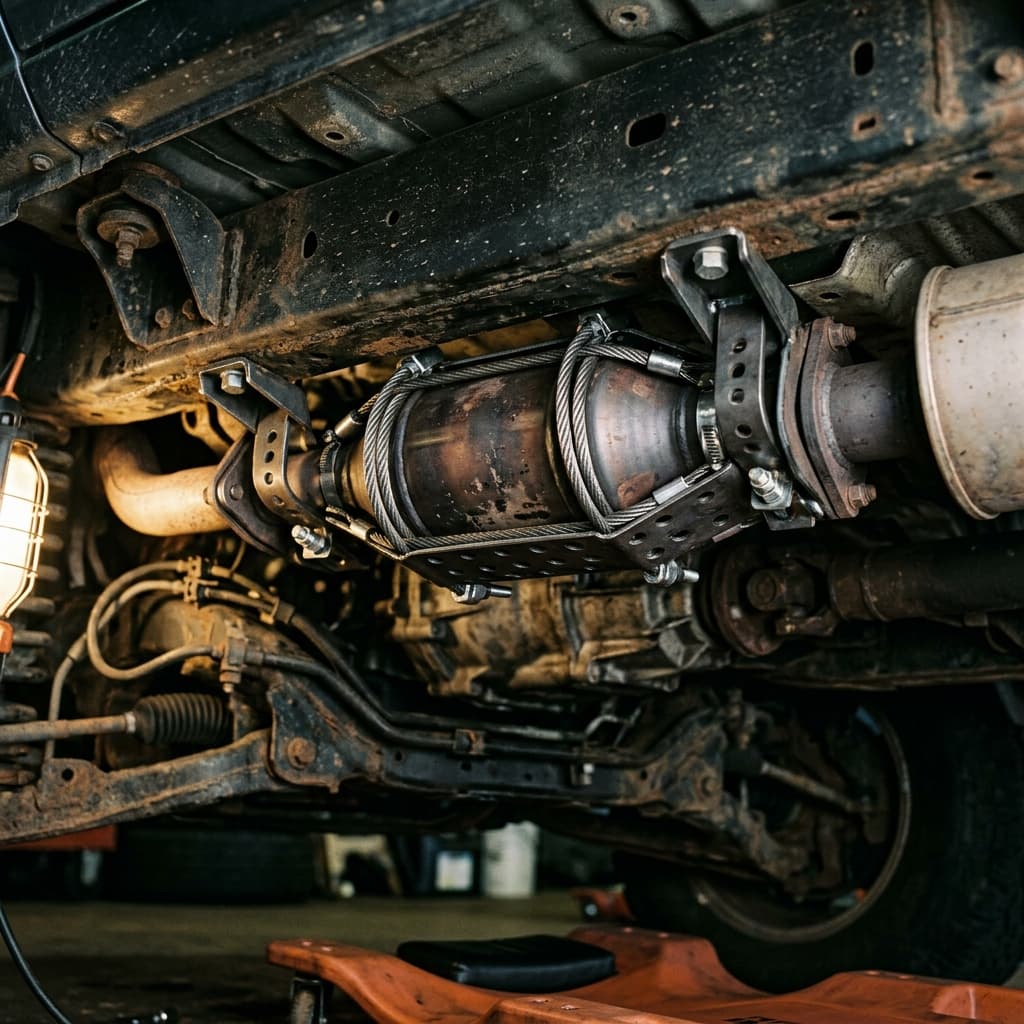
A catalytic converter anti-theft shield or cage is the most effective way to protect your vehicle. These devices cost $150 to $500 installed and add 10-15 minutes of cutting time — enough to make most thieves move to an easier target. After a 74% drop in claims during 2024, converter theft is showing signs of bouncing back in 2025-2026 as rhodium prices climb again. If you drive a Toyota Prius, Ford F-150, or Honda Accord, your car is on the list.
A thief with a battery-powered Sawzall can cut a converter off an unprotected vehicle in under 90 seconds. That's not hyperbole — it's been measured by law enforcement task forces in Houston, Los Angeles, and Minneapolis. The entire theft industry runs on speed. Every second of delay you add changes the math in your favor.
Which cars are most targeted?
Not every car is equally at risk. Thieves target specific vehicles based on ground clearance, converter value, and how fast they can get underneath. According to data from the NICB and State Farm claims reports, these are the primary targets:
| Vehicle | Why it's targeted | Converter value |
|---|---|---|
| Toyota Prius | Hybrid system preserves precious metals; highest PGM content | $300 – $1,500 |
| Toyota Tundra / Tacoma | High ground clearance, no jack needed; large V8 converter | $400 – $900 |
| Ford F-150 / F-250 | High clearance; dual converter setup on many models | $200 – $800 |
| Honda Accord | Palladium-rich catalyst blend; high recycler demand | $250 – $600 |
| Honda CR-V / Element | Higher ground clearance than sedans; easy access | $200 – $500 |
| Chevy Silverado / GMC Sierra | Dual converters; high clearance; heavy PGM loading | $200 – $500 each |
| Ford Econoline / E-Series | Commercial vans parked overnight; massive ground clearance | $150 – $400 |
Why the Prius tops every list: The Prius electric motor handles city driving, so the gasoline engine cycles on and off. Less heat cycling means the platinum, palladium, and rhodium coating on the ceramic substrate stays in better condition. Recyclers can extract more precious metal from a Prius cat than from a car that idled through 150,000 miles of stop-and-go traffic. That's why a Prius converter can be worth $1,500 while a Nissan Sentra's might bring $75.
Anti-theft devices compared
Here's an honest comparison of every major protection method, ranked by effectiveness:
| Device | Cost (installed) | Effectiveness | Best for |
|---|---|---|---|
| Bolt-on metal shield | $250 – $500 | ★★★★★ | Prius, trucks, fleet vehicles |
| Cable cage (CatClamp) | $150 – $300 | ★★★★ | Most cars, DIY install |
| Strap system (CatStrap) | $75 – $150 | ★★★ | Budget protection, visual deterrent |
| VIN etching | $20 – $50 | ★★ | Extra layer; makes converter traceable |
| High-temp paint | $10 – $20 | ★★ | Visual deterrent; signals other security |
| Tilt/motion alarm | $50 – $200 | ★★★ | Areas with nearby responders |
| Welding bolts shut | $30 – $75 | ★★ | Bolt-on converters (doesn't stop sawing) |
How to protect your catalytic converter: step by step
The best approach layers multiple deterrents. Here's what I'd do if I were parking a Prius or F-150 outside every night:
- Install a physical shield or cage. This is the single biggest upgrade. A model-specific bolt-on shield from MillerCAT, CatShield, or your vehicle manufacturer covers the converter completely. Get it welded if possible — bolted shields can eventually be unbolted, but welding adds another layer of difficulty.
- Etch your VIN onto the converter. Use a metal engraving pen ($15 at any hardware store) to etch your full 17-character VIN directly into the converter shell. This makes the part traceable and many scrap dealers will refuse to buy engraved converters.
- Paint it bright orange or neon green. Grab a can of high-temperature exhaust paint ($8-$12) and coat the visible surfaces. This signals to thieves that you've taken precautions, and it marks the converter as identifiable if stolen.
- Add a tilt/vibration alarm. Aftermarket systems that detect jacking or rocking trigger a loud siren. Not foolproof alone, but the noise draws attention.
- Park strategically. Garage parking is the ultimate protection. If that's not an option: park close to walls, under lights, near security cameras, or in high-traffic areas. Park with the exhaust side toward the curb or wall.
What does a stolen converter actually cost you?
Beyond the raw converter value, the real damage shows up in repair bills:
- Replacement OEM converter: $1,000 – $3,000 depending on the vehicle
- Labor for installation: $150 – $400
- Exhaust system damage: Thieves often cut through oxygen sensor wiring and damage the exhaust pipe. Add $100-$300 for additional repairs.
- Rental car while waiting for parts: OEM converters are backordered 2-6 weeks for popular vehicles. Budget $30-$50/day.
- Insurance deductible: If you file a comprehensive claim, you'll pay $250-$1,000 out of pocket.
Total real-world cost of a converter theft: $1,500 to $4,500+. A $300 anti-theft shield pays for itself the first time it works.
What to do if your converter is stolen
- Don't drive the car. You'll hear it immediately — the exhaust will be deafeningly loud and the engine will run rough.
- File a police report. You'll need the report number for your insurance claim.
- File a comprehensive insurance claim. Converter theft is covered under comprehensive, not collision.
- Get repair quotes. An aftermarket CARB-compliant converter is cheaper than OEM but may not be legal in all states (California requires CARB-certified units).
- Install an anti-theft device during the repair. You're already paying for exhaust work — adding a shield at the same time saves labor costs.
The theft trend: where things stand in 2026
After catalytic converter theft exploded between 2020 and 2022 (the NICB logged over 64,000 insurance claims in 2022 alone), thefts dropped sharply in 2023-2024. State Farm reported a 74% decline in claims during the first half of 2024 compared to 2023.
That decline tracked directly with falling rhodium prices. But rhodium has been climbing again since late 2024, and early 2025 data from cities like St. Paul (which saw a 193% increase) suggests the cycle is starting over. The takeaway: if you didn't protect your converter during the lull, now is the time.
Already lost your converter? Get a cash offer for the whole car.
Sometimes it makes more sense to sell the car than replace a $2,000+ converter. We'll make an offer based on what's left.
Get a Cash OfferInstall a physical anti-theft shield or cage ($150-$500 installed) that bolts to the vehicle frame. Combine it with VIN etching, high-temperature bright paint, and strategic parking. The physical barrier is the most effective single measure — it adds 10-15 minutes of cutting time, which deters most thieves.
The Toyota Prius tops every list because its hybrid system preserves precious metals. Other high-risk vehicles include Toyota Tundra, Tacoma, Ford F-Series, Honda Accord, Honda CR-V, and Chevy Silverado. Trucks and SUVs are targeted because their high ground clearance allows quick access underneath.
VIN etching kits start at $20. Cable locks (CatClamp) run $150-$300. Bolt-on metal shields cost $250-$500 installed. Given that a replacement converter costs $1,000-$3,000 plus labor, any anti-theft device pays for itself on the first prevented theft.
Yes — converter theft is covered under comprehensive insurance (not collision). You'll need to file a police report and pay your deductible ($250-$1,000). Some insurers may raise your premium after a claim. If you don't have comprehensive coverage, you're paying the full repair cost out of pocket.
About this guide: Written by the U-Pull-It.com Editorial Team. Theft statistics sourced from NICB reports and State Farm claims data. Anti-theft device pricing reflects retail and installed costs as of May 2026.