Published: April 28, 2026
· By U-Pull-It.com Editorial Team
Yes, you can sell a catalytic converter to a licensed junkyard, scrap dealer, or specialized catalytic converter recycler. But it is not as simple as walking in with a loose converter and walking out with cash. Since 2020, over 30 states have passed laws requiring sellers to prove ownership of the vehicle the converter came from. You will need a photo ID, the vehicle title or registration, and sometimes a signed affidavit.
This guide covers who buys converters, what they pay, the legal documentation you need in every state, and how to tell a legitimate buyer from a lowball operation.
Three types of buyers (and which pays the most)
Not all converter buyers are created equal. Where you sell determines how much you pocket:
| Buyer Type |
Typical Payout |
How They Price |
Best For |
| General junkyard / scrap yard |
$50 – $250 |
Flat rate based on converter size and vehicle type |
Convenience, selling attached to a junk car |
| Specialized cat recycler |
$100 – $1,500 |
XRF assay of actual precious metal content |
Maximum payout, high-value converters |
| Online mail-in buyer |
$75 – $1,000 |
Serial number lookup against price database |
No local buyers, bulk sellers |
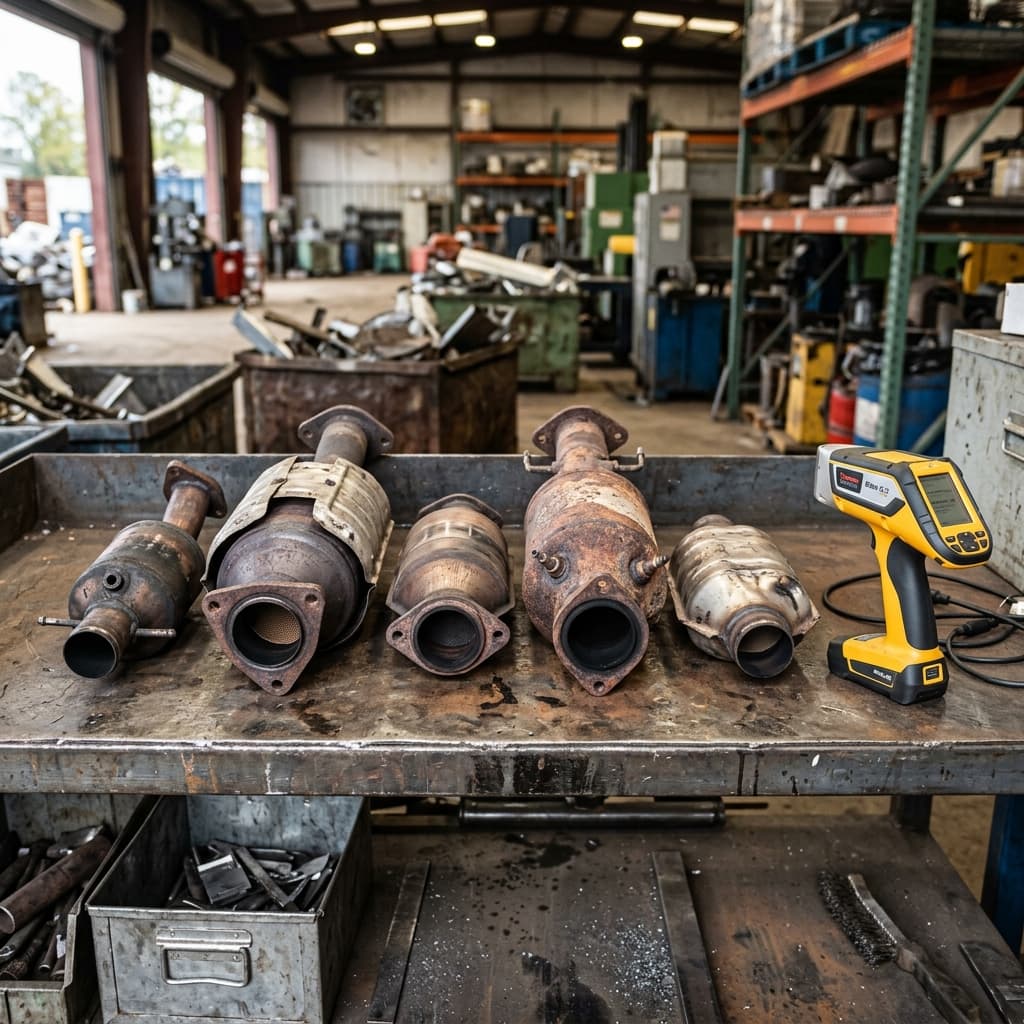
Why specialized recyclers pay more: A general scrap yard uses flat-rate pricing — they guess the value based on the converter's size and appearance. A specialized recycler uses an X-ray fluorescence (XRF) analyzer that measures the exact amount of platinum, palladium, and rhodium in the honeycomb substrate. That precision means higher payouts, especially on high-value converters from Toyota, Honda, and Ford trucks.
What documentation do you need?
The exact requirements vary by state, but here is the baseline that most licensed buyers now require:
⚠️ Documents you should bring
- Valid government-issued photo ID (driver's license or state ID)
- Vehicle title or registration proving you own the car the converter came from
- VIN of the source vehicle (some states require this on a separate form)
- Signed affidavit of ownership (required in CA, TX, IL, FL, NY, and others)
If you are selling a converter that was removed from a car you already junked, bring the receipt from that sale showing the converter was not included.
State-by-state rules at a glance
| State |
ID Required? |
Title/Reg Required? |
Waiting Period |
Cash Allowed? |
| California | Yes | Yes + dismantler license | None | No (check only) |
| Texas | Yes | Yes | 14 days | No (check only) |
| Florida | Yes | Yes + VIN | 5 days | No (check only) |
| New York | Yes | Yes | 10 days | No |
| Illinois | Yes | Yes | 7 days | No |
| Ohio | Yes | Yes | None | Yes (under $100) |
| Georgia | Yes | Yes | 3 days | No |
| Arizona | Yes | Recommended | None | Yes |
This table covers the major states, but laws are changing fast. If your state is not listed, call your local salvage yard and ask what documentation they require. A legitimate buyer will always tell you upfront.
Selling attached vs. selling loose
You have two options, and the math works differently for each:
- Attached to the car (recommended): Sell the entire vehicle to a junk car buyer. The converter value gets rolled into your total offer. One transaction, one tow, one check. Most people net more this way because the car retains full value.
- Sold separately: You might get a higher price for the converter alone from a specialized recycler, but the remaining car loses $200–$500 in value without it. Do the math before cutting it off. See our catalytic converter scrap value guide for current pricing.
How to get the best price
- Find the serial number. Look at the metal shell for a stamped code (usually 5-8 digits). This identifies the converter model and gives buyers a precise value.
- Get 3+ quotes. Call at least one general scrap yard, one specialized recycler, and one online buyer. Prices vary by $100-$400 for the same converter.
- Ask if they use XRF assay. Buyers who measure the actual metal content pay more than flat-rate buyers. If they "eyeball" your converter, they are guessing low.
- Sell OEM, not aftermarket. Factory-original converters contain substantially more precious metals than cheap aftermarket replacements. If your cat is aftermarket, expect $10–$30.
Red flags: how to spot a bad buyer
- Pays cash with no documentation: Legitimate recyclers are required by law to keep records. Cash-only, no-ID buyers are either unlicensed or dealing in stolen goods.
- No fixed business address: Mobile "cat buyers" who meet you in parking lots are often unlicensed. Deal with established businesses that have a physical location.
- Quotes a price without seeing the converter: Anyone who offers a firm price over the phone without knowing the serial number is guessing — usually low.
- Pressure to sell immediately: A reputable buyer will give you time to compare offers. If they pressure you to "sell now before prices drop," walk away.
Selling a car with the cat still attached?
We factor the catalytic converter, engine, and transmission into every offer. Free towing, paid on the spot.
Get Your Instant Cash Offer
Can you sell a catalytic converter to a junkyard?
Yes. Licensed junkyards, scrap dealers, and catalytic converter recyclers all buy used converters. Most states now require proof of ownership (photo ID, vehicle title or registration). Selling without documentation is illegal in many jurisdictions.
How much will a junkyard pay for a catalytic converter?
General junkyards pay $50–$250 for standard converters. Specialized recyclers with XRF assay equipment pay 20–40% more. High-value converters from Toyota, Honda, and Ford trucks can bring $300–$1,500 from the right buyer.
Is it illegal to sell a catalytic converter?
Selling a converter you legally own is not illegal. Selling without proof of ownership, selling stolen converters, or buying from unlicensed sellers is illegal in most states. Over 30 states have passed specific catalytic converter laws since 2020.
Should I sell the converter separately or attached to the car?
For most people, selling the car whole (with the converter attached) nets more total money. Removing the cat drops the car's value by $200–$500. Only sell separately if you have a specialized recycler offering a significant premium over what the junkyard will pay for the complete vehicle.
About this guide: Written by the U-Pull-It.com Editorial Team. Laws and prices reflect conditions as of April 2026. Regulations change frequently — contact your local salvage yard or attorney for current requirements.