How to Read a VIN to Find Compatible Donor Cars for Parts
Understanding the VIN Structure for Parts Compatibility When searching for compatible donor cars for parts, understanding how to read a Vehicle Identification Number (VIN) is absolutely crucial. The VIN is a unique 17-character code that contains vital information about a vehicle's manufacturer, model year, engine type, transmission, and trim level. This information becomes invaluable when [...]
Article image
Understanding the VIN Structure for Parts Compatibility
When searching for compatible donor cars for parts, understanding how to read a Vehicle Identification Number (VIN) is absolutely crucial. The VIN is a unique 17-character code that contains vital information about a vehicle's manufacturer, model year, engine type, transmission, and trim level. This information becomes invaluable when you need to find the right parts from salvage yards near me or auto wrecking yards.
Each VIN follows a standardized format established by the National Highway Traffic Safety Administration (NHTSA) since 1981. This standardization means that every passenger car and light truck manufactured has a consistent 17-character structure that can be decoded to reveal specific vehicle details essential for parts matching.
Breaking Down the 17-Character VIN Code
VIN Position
Information Revealed
Parts Compatibility Relevance
1-3 (WMI)
World Manufacturer Identifier
Identifies manufacturer and country of origin
4-8 (VDS)
Vehicle Descriptor Section
Engine type, transmission, body style, restraint systems
9
Check Digit
Validates VIN authenticity
10
Model Year
Critical for parts compatibility timing
11
Assembly Plant
Manufacturing location identifier
12-17 (VIS)
Vehicle Identifier Section
Unique production sequence number
The most critical positions for parts compatibility are positions 4-8 and position 10. These sections reveal the engine specifications, transmission type, and model year – all essential factors when determining if parts from a donor vehicle will fit your car.
When looking for donor cars at junkyards for OEM parts, follow this systematic approach to ensure compatibility:
Phase 1: VIN Location and Recording
Dashboard location – Near the windshield on the driver's side
Driver's door jamb – Inside the door frame
Vehicle paperwork – Registration, insurance documents, or title
Engine bay – Often stamped on the engine block or firewall
Phase 2: Decoding and Analysis
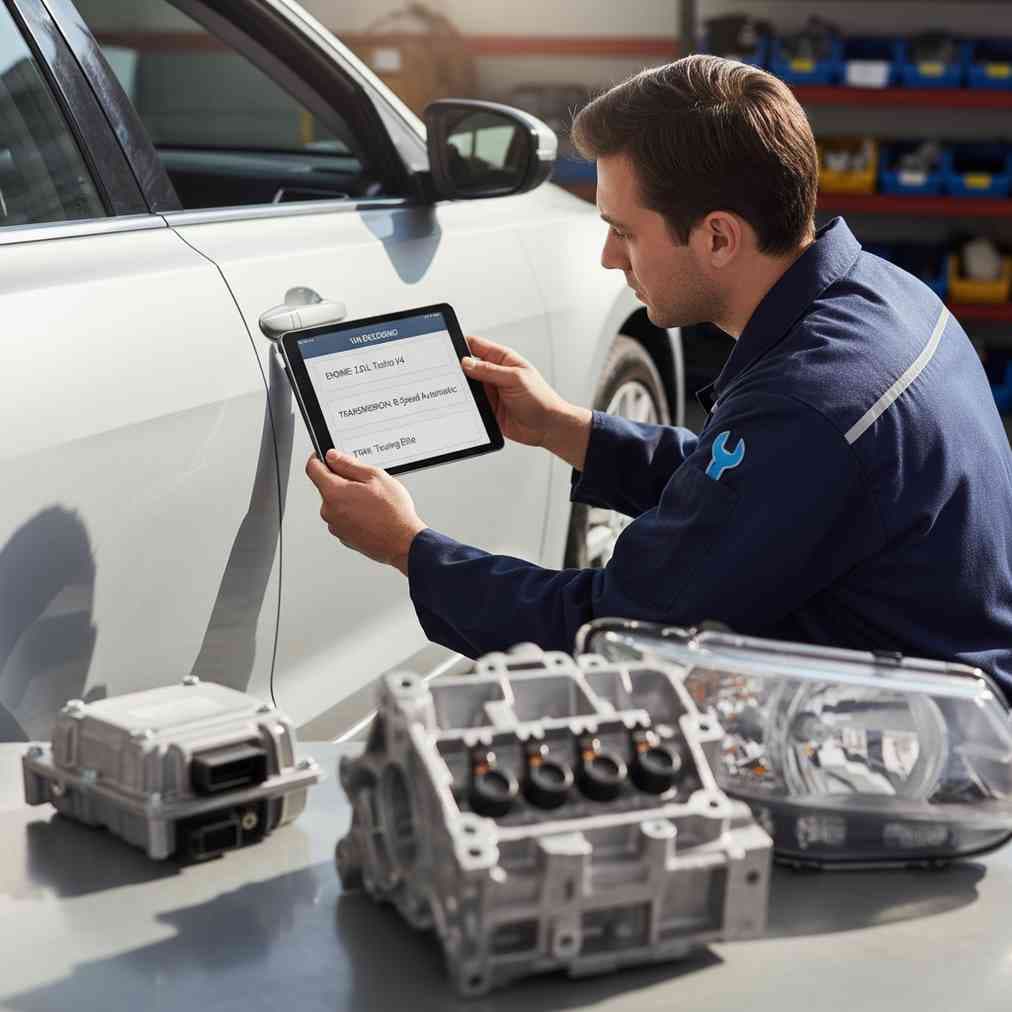
Input the complete 17-digit VIN into a reliable decoder tool
Extract key specifications including engine code, transmission type, and trim level
Note any specific option packages or manufacturing variations
Cross-reference with your vehicle's VIN for compatibility confirmation
Phase 3: OEM Part Number Verification
The decoded VIN information guides you to exact OEM (Original Equipment Manufacturer) part numbers. Many original parts have stamped or printed OEM numbers (e.g., “VW 06B 903 023”) that help cross-verify compatibility between your vehicle and the donor car.
Critical Parts Matching Checklist
Before purchasing parts or selecting donor vehicles, use this comprehensive verification checklist:
Verification Step
Key Details to Confirm
Why It Matters
Engine Specifications
Engine size, type (V6, 4-cylinder, diesel), specific codes
Ensures proper fitment for engine components
Transmission Type
Automatic vs manual, gear count, specific model
Critical for drivetrain component compatibility
Trim Level Matching
LX, EX, Sport variants and option packages
Affects suspension, interior, and body components
Model Year Verification
Exact production year from position 10
Prevents incompatibilities from mid-year changes
Safety Component Check
Airbag systems, seatbelts, crash sensors
Ensures no recall-related safety issues
Pro Tip: Always cross-reference VIN-decoded information with OEM part catalogs or inspect existing parts for stamped OEM numbers. This dual verification approach significantly reduces compatibility errors.
Ignoring mid-year production changes – Manufacturers sometimes modify specifications during a model year
Assuming trim level compatibility – Different trim levels may have incompatible suspension, brake, or electrical components
Overlooking recall information – Some parts may have safety recalls that make them unsuitable for reuse
Relying solely on model year – Engine and transmission options can vary significantly within the same model year
Skipping OEM number verification – VIN decoding should always be confirmed with actual OEM part numbers
Advanced VIN Analysis for Complex Parts
Modern vehicles increasingly feature complex electronic systems and customization options. For components like turbochargers, transmissions, or electronic control modules, deeper analysis may be required:
Electronic Systems Compatibility
ECU programming – Electronic control units may require specific software versions
Wiring harness variations – Different trim levels may have incompatible electrical connections
Sensor compatibility – Advanced safety systems require precise sensor matching
Communication protocols – Modern vehicles use specific data bus systems that must match
Hybrid and Electric Vehicle Considerations
The rise of electric vehicle parts from junkyards introduces new complexity layers. VIN decoders must accurately interpret advanced powertrains, battery systems, and high-voltage components that require specialized handling and compatibility verification.
Maximizing Your Parts Search Success
To increase your success rate when looking for compatible donor cars, consider these strategic approaches:
Multiple Verification Sources
Use multiple VIN decoder tools to cross-verify information
Consult manufacturer-specific parts diagrams when available
Check with dealership parts departments for complex components
Utilize aftermarket parts databases for additional confirmation
Documentation and Record Keeping
Photograph both your vehicle's VIN and the donor vehicle's VIN
Save decoder results for future reference
Record OEM part numbers from removed components
Maintain a compatibility database for your specific vehicle model
Industry Trends and Future Developments
The automotive salvage industry continues evolving with enhanced digital VIN decoding databases. These improvements have increased precision in matching transmission and engine types, reducing errors especially in vehicles with multiple trim variations across the same model year.
Enhanced VIN decoding capabilities now include more detailed option code interpretation and better integration with manufacturer electronic parts catalogs (EPCs). Many salvage yards now use VIN matching software to quickly identify and remove recalled or incompatible parts from inventory, streamlining safe parts resale.
Getting Professional Help
When dealing with complex or high-value components, don't hesitate to seek professional assistance. Many experienced salvage yard operators can help decode VINs and verify compatibility. If you're considering selling your junk car for cash to fund your parts purchase, professional evaluation can ensure you get the best value.
Remember that VIN decoding is just the first step in successful parts sourcing. Combined with careful physical inspection, OEM number verification, and professional guidance when needed, VIN analysis becomes a powerful tool for finding exactly the right parts for your vehicle repair or restoration project.
Conclusion
Mastering VIN decoding for parts compatibility opens up significant opportunities for cost savings and successful vehicle repairs. By understanding the 17-character structure, utilizing reliable decoder tools, and following systematic verification processes, you can confidently identify compatible donor vehicles and source the exact parts you need.
The key to success lies in thorough verification – never rely on a single source of information. Cross-reference VIN data with OEM numbers, use multiple decoder tools, and don't hesitate to seek professional verification for critical components. With these skills and knowledge, you'll transform from a casual parts searcher into an informed buyer who consistently finds high-quality, compatible parts at fraction of new parts costs.