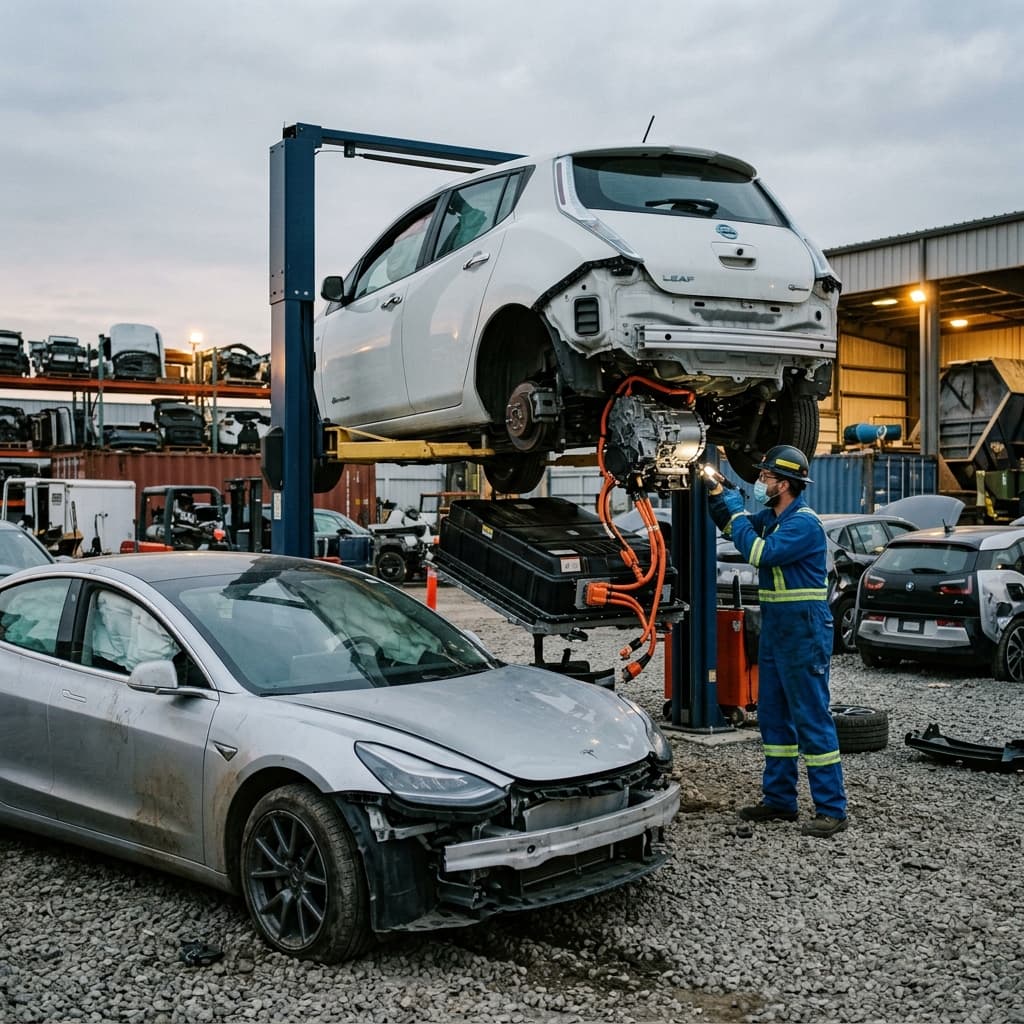
Electric vehicles are arriving at salvage yards in growing numbers as early Nissan Leafs, Chevy Bolts, and Teslas hit end-of-life or get wrecked. Many parts — headlights, body panels, seats, suspension, brakes — are safe to pull just like any gas car. But high-voltage components (battery packs, drive motors, inverters) operate at 400-800 volts and can kill you. This guide covers what you can safely grab, what requires a professional, and where to find tested EV components.
High-voltage safety warning
EV battery packs operate at 400-800 volts — enough to kill instantly. Never cut, puncture, or disassemble any component marked with orange wiring or high-voltage labels. Damaged lithium-ion batteries can experience "thermal runaway" — a self-sustaining chemical reaction causing extreme heat, fire, and explosion — hours or even days after initial damage. If you're not a certified EV technician with proper PPE, stay away from the orange cables.
What's safe to pull from an EV (DIY-friendly)
These components use standard 12V electrical systems and are no different from pulling parts off a gas car:
- Body panels: Fenders, doors, hoods, trunk lids, bumper covers
- Headlights and taillights: Often LED units worth $200-$500+ new
- Side mirrors: Heated, auto-dimming, camera-equipped mirrors from Teslas are especially valuable ($150-$400)
- Interior: Seats, door panels, steering wheels, screens/infotainment (note: Tesla screens may be software-locked)
- Suspension: Struts, springs, control arms, sway bars — standard mechanical components
- Brakes: Calipers, rotors, pads — EVs often have barely-used brakes due to regenerative braking
- Wheels and tires: EV-specific low-rolling-resistance tires are expensive new
- 12V battery and accessories: Standard 12V system components (not the high-voltage pack)
What requires professional handling (NOT DIY)
| Component | Voltage | Risk | Used Price Range |
|---|---|---|---|
| Battery pack | 400-800V | Electrocution, thermal runaway, fire | $2,000 – $15,000+ |
| Drive motor | 400-800V | Electrocution, stored energy | $1,500 – $5,000 |
| Inverter/charger | 400-800V | Electrocution, capacitor discharge | $500 – $3,000 |
| Orange HV cables | 400-800V | Electrocution | $100 – $400 |
Used EV battery pack pricing (2026)
| Vehicle | Pack Size | Used Price | Notes |
|---|---|---|---|
| Nissan Leaf (2011-2017) | 24-30 kWh | $2,000 – $4,000 | Air-cooled; degradation common in hot climates |
| Chevy Bolt (2017-2023) | 60-66 kWh | $4,000 – $8,000 | Recall-related availability; liquid-cooled |
| Tesla Model 3 SR+ | 50-60 kWh | $6,000 – $10,000 | LFP or NCA chemistry; software-locked |
| Tesla Model 3 LR/Perf | 75-82 kWh | $8,000 – $15,000 | High demand for conversions |
| Ford Mach-E | 68-91 kWh | $5,000 – $12,000 | Limited salvage supply currently |