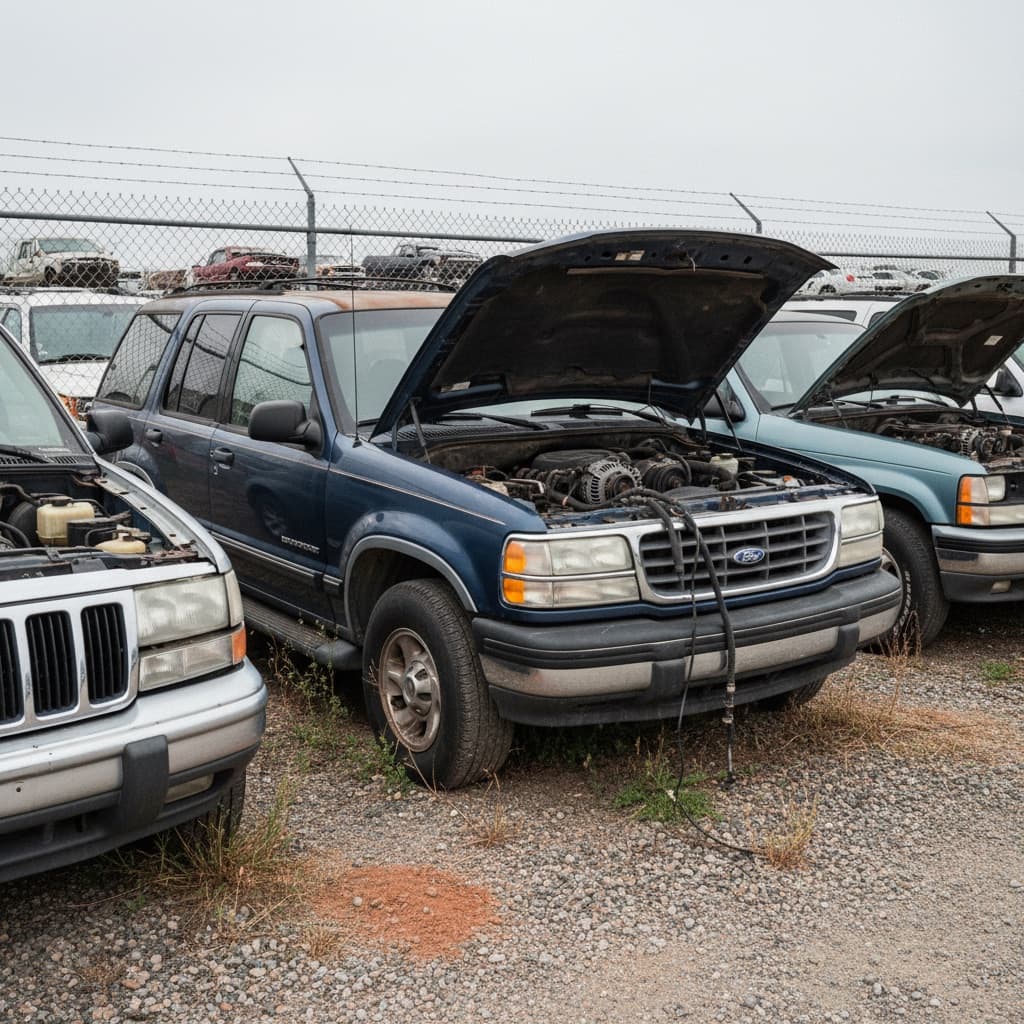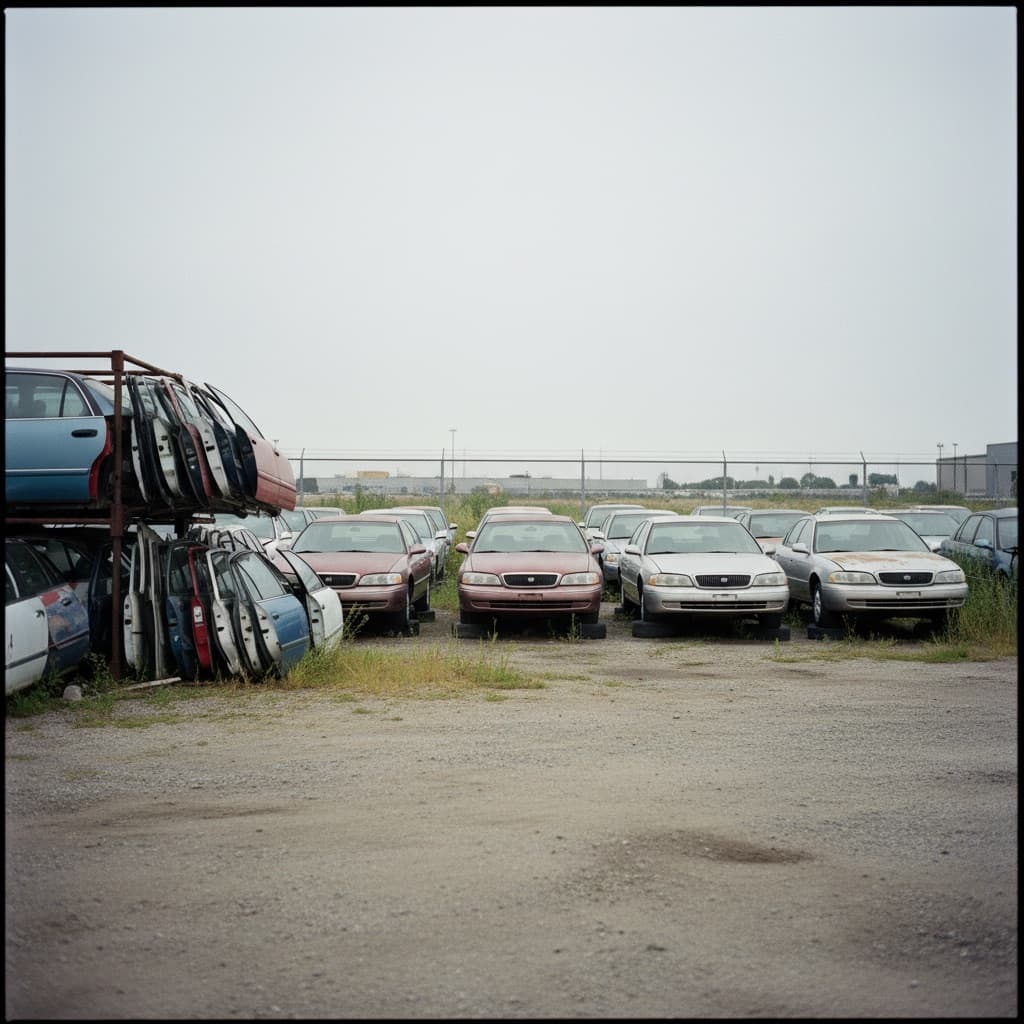
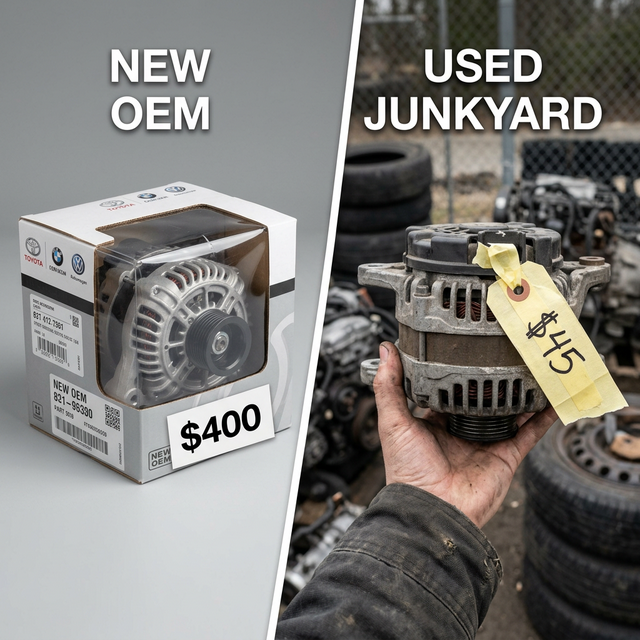
Auto salvage yards are the best-kept secret in automotive repair. By sourcing used OEM parts directly from donor vehicles, most DIYers cut repair costs by 70–90% without giving up quality. A $400 alternator at the dealer costs $45 at a U-Pull yard. A $1,800 transmission costs $200. The savings are real, and they compound fast if you know what you're doing.
This is the master guide. It covers the full process — from research to installation — with deeper dives linked at each step. Whether you've never visited a junkyard or you're looking to stop making expensive mistakes, start here.
Guide Chapters- Step 1 — The essential gear
- Step 2 — Finding compatible parts (sister cars)
- Step 3 — Reading donor vehicles
- Step 4 — Scrap or repair?
- Step 5 — Selling your junk car
- The DIY salvage matrix
⚠️ Critical safety — read before your first visit
- Never go under a vehicle that isn't on rated jack stands. Yard cars are not on proper supports.
- Wear eye protection and heavy-duty gloves from the moment you arrive. Sheet metal edges and dried rubber seals cut without warning.
- If you're working near airbag (SRS) components or hybrid/EV orange high-voltage cables, stop and research the specific safety protocol before touching anything.
- No open flames near fuel systems. Old cars can have leaky fuel lines.
Step 1 — The essential gear: what's in your bag?
You can't pull a transmission with a screwdriver. The difference between a two-hour pull and a twenty-minute pull is almost always the tools. A good junkyard bag balances portability with coverage — you're walking across a muddy lot, not driving a tool truck up to the car.
The non-negotiables: a 3/8" ratchet with a metric and SAE socket set (8mm–19mm), a breaker bar for rusted bolts, plastic trim pry tools, needle-nose pliers, and PB Blaster to spray on corroded fasteners 10 minutes before you turn them. That kit handles 80% of everything you'll ever pull.
The upgrades that actually matter: a cordless impact wrench cuts removal time by 70%, a digital multimeter lets you test electrical parts before you pay for them, and a 12V portable jump starter lets you test power windows, fans, and seat motors right at the donor car. Bring those three and you'll make better decisions and faster pulls every trip.
The real cost math: A full professional brake job (pads + rotors, both axles) at a shop runs $400–$700. Pulling rotors and calipers at a U-Pull yard: $20–$45 in parts. The tools to do it: a one-time $80 investment that pays for itself on the first trip.
Step 2 — The "sister car" secret: finding compatible parts
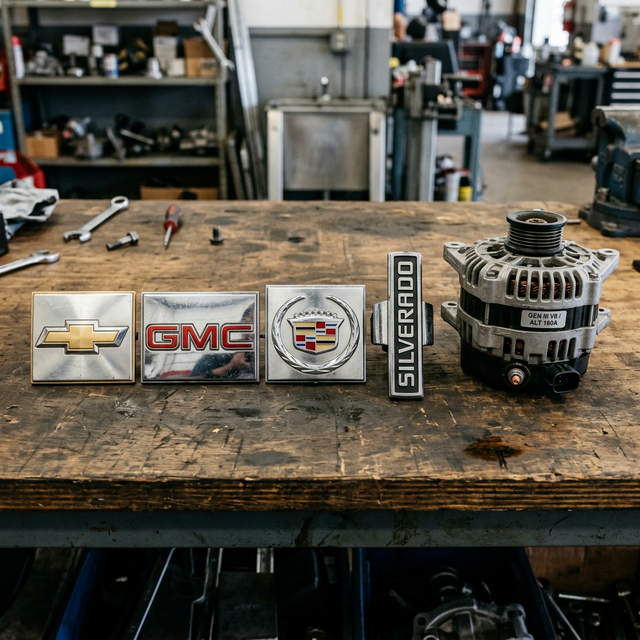
Most people walk into a salvage yard looking for their exact year, make, and model. When they don't see it, they leave. That's a mistake that costs time and money every time it happens.
Automakers build multiple vehicles on the same platform — same chassis, same engine family, same supplier parts — to reduce manufacturing costs. A Chevy Silverado alternator often fits a GMC Sierra, a Chevy Tahoe, and a Cadillac Escalade from the same generation. You may have three times as many donors available as you thought.
The industry tracks all of this through the Hollander Interchange Manual, the standard database used by every salvage yard in North America. Parts that share a Hollander number are confirmed interchangeable. Give the number to the clerk at the front desk and they can search the entire yard for matching donors in 30 seconds.
Master Class: 10 Interchangeable Auto Parts — The Sister Car Guide → The complete breakdown of which parts cross over between platforms, including a sister car cheat sheet and how to verify before you pull. Reference: The Part Compatibility Matrix → The master interchange table covering Toyota, Honda, GM, Ford, and VW platforms — with the three verification checks (VIN digit, pin count, Hollander number) that catch 95% of mismatches.Step 3 — Reading donor vehicles: goldmine vs. garbage
Not all cars in the yard are equal. A car with a smashed rear end and deployed airbags was running at the moment of impact — a goldmine. A car with zero body damage is usually there because something catastrophic failed mechanically. Reading that story before you touch a wrench is how you avoid a bad pull.
Two-minute inspection: pull the oil dipstick (golden amber oil means green flag; milky froth means blown head gasket — walk away from the entire drivetrain). Check the interior for flood lines or a musty smell (corrosion has already wicked through every connector — avoid all electrical parts). Look for fresh service stickers on the windshield corner or around the oil cap (evidence someone maintained the car before it ended up here).
For major purchases — engines, transmissions, control modules — ask the yard clerk for the donor's 17-digit VIN and run it on vincheck.info (free, NMVTIS federal database). A flood or fire title on that donor means those parts will fail inside your car, sometimes within weeks of installation. Two minutes on your phone prevents a $500 mistake.
Expert Strategy: How to Read a Donor Vehicle's History → The full green flag / red flag system, a 60-second part-specific inspection table (engine, transmission, alternator, sensors), VIN check workflow, and negotiation tactics at checkout.Ready to find your part?
Our inventory updates daily with hundreds of fresh donor vehicles across our locations. Search by year, make, and model — free, no account needed.
Search Live Inventory NowStep 4 — Scrap or repair? Making the right call
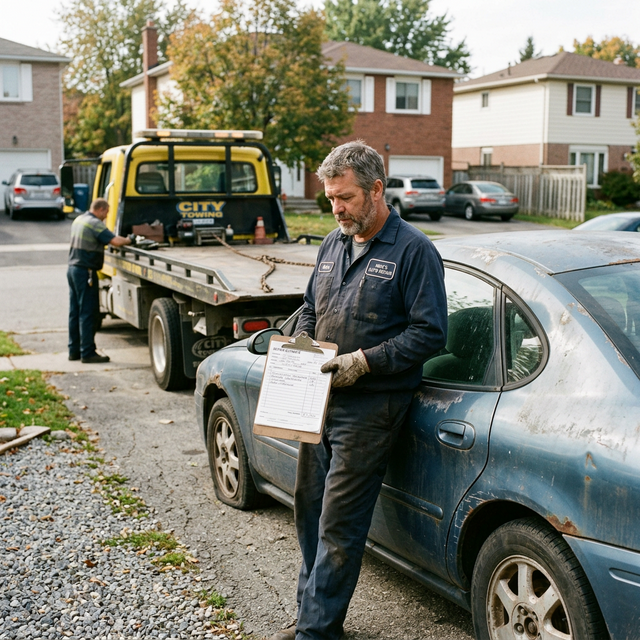
Sometimes the car is beyond a part swap. Mechanics and insurance adjusters use the 70% rule internally: if the repair quote exceeds 70% of the vehicle's fair market value in good condition, the economics stop working. You're spending near-replacement money on something that won't be worth replacement money afterward.
A $3,500 transmission for a 2010 Nissan Altima that books at $4,000 clean is 87% of the car's value — for one repair. If the car is over 150,000 miles, has rust issues, and you don't know what else is coming, that's a $3,500 bet with poor odds. A licensed salvage yard will often pay $400–$800 for that same car. High-value components — catalytic converter ($100–$1,000+ depending on precious metals), aluminum wheels, engine core — pull real money even on a beat-up vehicle.
Is the repair quote too high?
Many U-Pull-It customers choose to sell their car with a bad transmission directly rather than sinking $3,000–$5,500 into a rebuild. The catalytic converter, running engine, and body panels still have real value. See what your car with a failed transmission is worth here.
Step 5 — Turning rust into cash: selling your car
If the car is going, maximize what you get from it. The two things that matter most: paperwork and completeness. A car with its catalytic converter, battery, and wheels intact commands a meaningfully better offer than one that's been partially stripped.
A clean title always gets the best offer. If yours is lost, most states issue a duplicate for $15–$25 in 1–3 business days. If you genuinely can't get a title, reputable salvage yards have legal workflows for older vehicles — a notarized affidavit of ownership, valid photo ID, and current registration covers most situations. What you cannot do is sell a car you don't legally own.
Before the car leaves: cancel your insurance, remove your plates, and clear everything personal. People forget this regularly and pay months of premiums on a car that was crushed two days later.
Legal Guide: How to Sell a Car Without a Title → Covers duplicate title replacement, the paperwork survival kit (affidavit, bill of sale, registration), state-specific rules for TX, FL, and IL, and what a Certificate of Destruction means for your liability.The DIY salvage success matrix
Before every yard visit, run through this. Five minutes of planning prevents the mistakes that cost you hours.
| Phase | What to do | Key resource | Common mistake to avoid |
|---|---|---|---|
| Research | Verify part compatibility, find your Hollander number before you go | Part Compatibility Matrix | Showing up without knowing which sister cars also work |
| Preparation | Pack the right tools, bring PB Blaster, charge the jump starter and multimeter | Tool Checklist | Arriving with only hand tools and no way to test electrical parts |
| Selection | Read crash damage, check oil, look for service stickers, run the VIN | Donor History Guide | Pulling from a zero-damage car without checking for mechanical failure |
| Inspection | Test electrical parts with a multimeter, spin bearings by hand, check fluid color | Part Inspection Table | Pulling without testing and discovering a bad part after installation |
| Execution | Photograph the part in place before removal, bag and label all bolts and hardware | U-Pull-It Safety Protocol | Losing fasteners, skipping the photo, missing a connector |
| Checkout | Point out defects for a discount, confirm return policy, keep the receipt | Search Live Inventory | Paying full price without asking, losing the receipt on a part that fails |
Typically 70–90% compared to new OEM dealer prices. A $400 alternator at the dealer costs $40–$65 at a U-Pull yard. A $1,800 transmission drops to $150–$300. The savings are largest on drivetrain and electrical parts — the categories where dealers and auto parts chains charge the highest markups.
You bring your own tools, find the donor vehicle in the lot yourself, remove the part, and pay a fixed price at the front counter. Because you do the labor, prices are far lower than full-service yards where staff pull the part for you. The tradeoff: you're responsible for knowing which part you need and verifying it's in good condition before you buy.
For most mechanical parts, yes — if you pick the right donor. OEM parts from the factory are manufactured to tighter tolerances than most aftermarket suppliers. A used alternator from a well-maintained donor with clean oil and no flood history will typically outlast the $29 aftermarket replacement from an auto parts chain. The key is knowing how to evaluate the donor before you pull.
Most U-Pull yards offer 30-day exchange or store credit on most mechanical parts. Electrical components — sensors, ECUs, modules — are often sold as-is because they can't be easily tested at the yard counter. That's exactly why you test them with a multimeter before pulling. Always ask about the return policy at the counter before you pay, and keep your receipt.
Yes — battery-powered cordless tools are allowed and encouraged at most U-Pull yards. Torch cutting and gasoline-powered tools are prohibited. A cordless impact wrench is the biggest quality-of-life upgrade from the basic hand-tool kit. What takes ten minutes by hand takes thirty seconds with a Milwaukee M18 or DeWalt 20V. Bring a fully charged battery and a spare.
The Hollander Interchange Manual is the industry-standard database used by virtually every salvage yard in North America. It assigns a unique number to each group of interchangeable parts. Two parts with the same Hollander number are confirmed compatible regardless of make or model. Give the number to the yard clerk and they can search your entire interchange group across the yard's full inventory in about 30 seconds.
When the repair quote exceeds 70% of the vehicle's fair market value. Other clear triggers: a blown head gasket on a high-mileage engine (repair can run $2,500+), deployed airbags on an older vehicle ($2,000–$5,000 to fix the SRS system properly), severe flood damage, or frame damage. Before you authorize any repair over $1,500 on a car worth less than $5,000, get a scrap quote first.
About this guide: Written by the U-Pull-It.com editorial team based on experience processing hundreds of thousands of parts transactions across our self-service salvage yard locations in Florida. U-Pull-It is a licensed salvage facility.