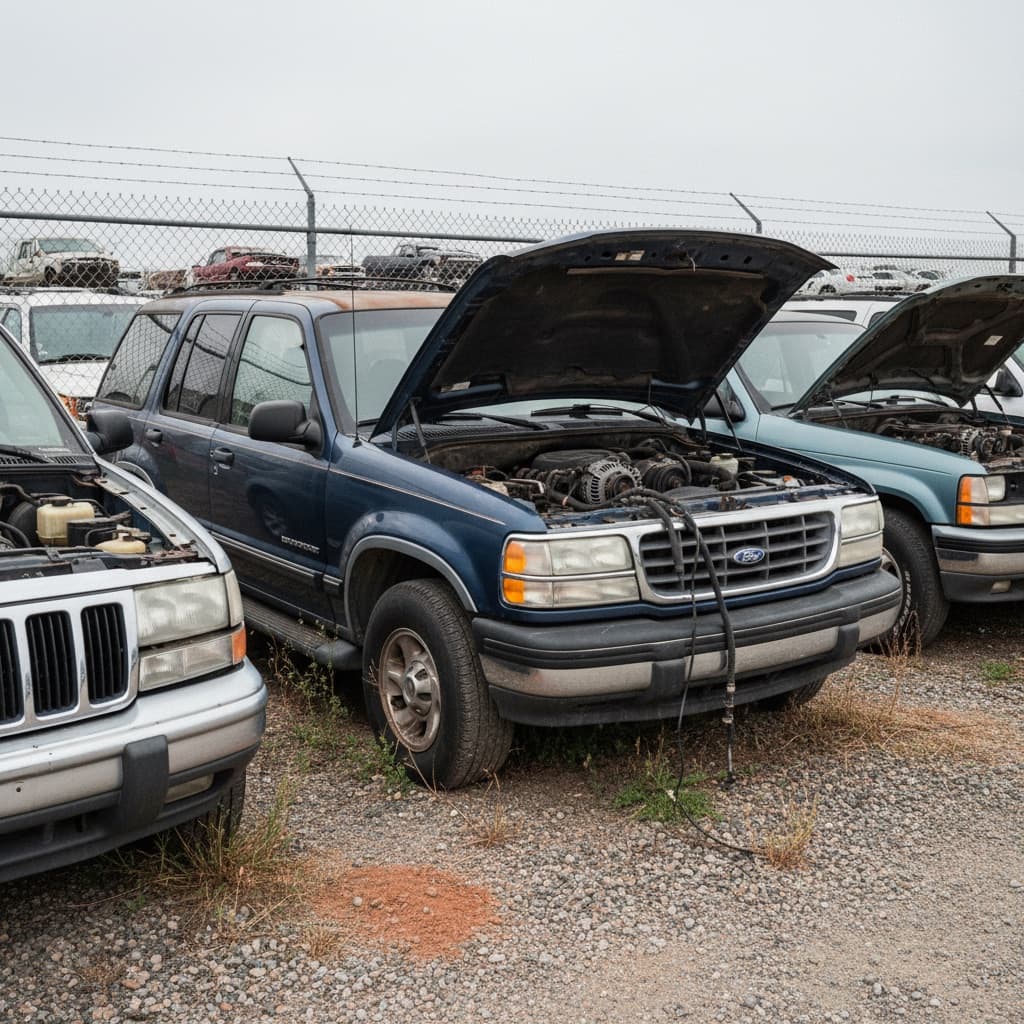
Can't find your specific year and model in the yard? You might be looking for the wrong car.
Most people walk into a u-pull-it yard looking for an exact match — same year, same model. When they don't find it, they leave. That's a mistake. Automakers have been sharing platforms, parts, and tooling across brands for decades to control manufacturing costs. The result is that your Honda Civic shares literal bolt-on components with the Acura ILX. Your Toyota Camry can accept seats and mirrors from a Lexus ES. Your F-150 alternator bolts right into a Lincoln Mark LT.
Once you understand how "sister cars" work, the yard looks very different.
⚠️ The Compatibility Check — Do This Before You Pull
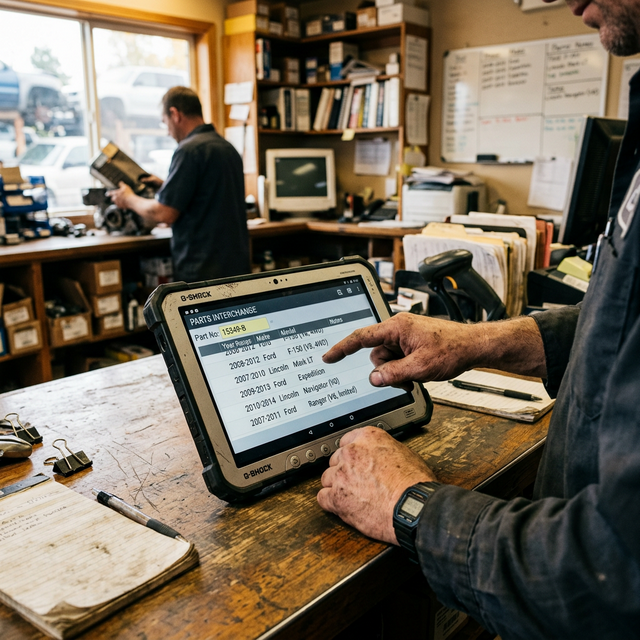
Visual Match Hold the donor part next to your original. Casting numbers, mounting holes, and connector locations should all line up before you start unbolting. Plug Check For anything electrical — mirrors, sensors, switches — verify the connector shape and pin count are identical. Use the Hollander Guide Ask at our front desk. We have access to the Hollander Interchange system, which cross-references part numbers across makes and model years in 30 seconds.The top 10 parts that cross over between cars
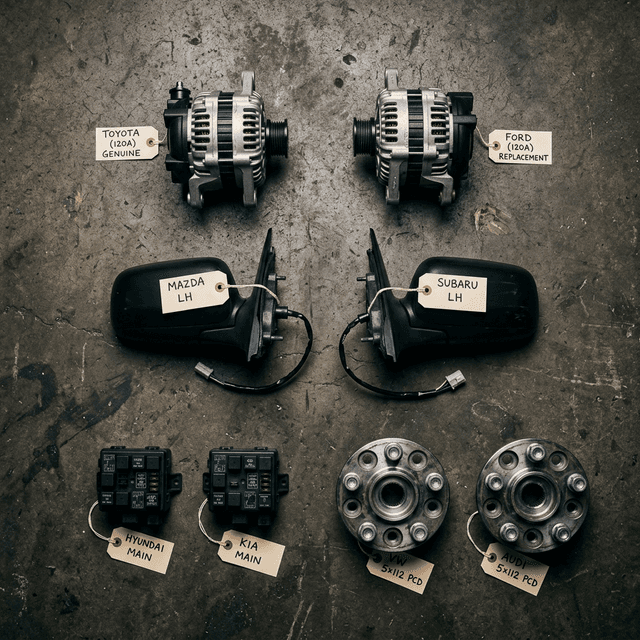
Alternators and starters. Bosch, Denso, and Mitsubishi Electric supply alternators to multiple automakers at once, often with the same internal specs. GM truck alternators — Silverado, Sierra, Tahoe, Suburban, Yukon — share 105A and 145A units across the platform. Power door mirrors. Toyota and Lexus share exterior mirror assemblies extensively. A Lexus ES300 mirror often bolts onto a Camry of the same generation. Honda Civic and Acura ILX/EL share mirror bases and glass. Relays and fuses. Within the same manufacturer's lineup, relays are nearly universal. A Bosch mini relay (30/40A, 12V, 5-pin) appears in dozens of vehicles from VW, Audi, BMW, Volvo, and Mercedes across multiple decades. Wheels and rims. The 5x114.3 bolt pattern is shared by Honda, Acura, Nissan, Infiniti, Toyota, Hyundai, Kia, Mazda, and Mitsubishi. A set of 17" rims from a Nissan Altima will physically fit a Honda Accord of the same generation. Interior door handles. GM's GMT800 and GMT900 trucks (Silverado, Sierra, Tahoe, Yukon, Suburban, Escalade) share interior door handle assemblies across the lineup. Window regulators and motors. A 2002–2006 Camry window regulator will interchange directly with the Solara and sometimes the Avalon of the same generation. Water pumps and thermostats. Engine-based parts follow the engine, not the badge. If a 2.5L inline-four from Nissan appears in the Altima, Sentra, and Frontier, the water pump is the same across all three. Fuel injectors. A 2003 Honda Accord 2.4L injector (Denso 16450-RAA-A01) crosses directly with the Element and CR-V using the same engine. Match by flow rate and connector type. Brake calipers and rotors. GM Delta platform (Cobalt, G5, HHR, Ion) uses the same front brakes throughout. Front calipers are platform-wide in most generations. HVAC blower motors. Toyota's HVAC supplier (Denso) builds blower units that appear across Camry, Avalon, Lexus ES, and Solara with the same connector and mounting bracket.The "Sister Car" cheat sheet

| Your Car | Look for These Donors Too | Notes |
|---|---|---|
| Honda Civic | Acura EL, Acura ILX, Honda CR-X (older) | Most body and interior parts, 2001–2015 |
| Toyota Camry | Lexus ES300/ES350, Toyota Avalon, Toyota Solara | Platform-wide sharing from 1997–present. Seats, HVAC, window regulators. |
| Ford F-150 | Lincoln Mark LT, Ford Expedition, Ford Navigator | Engines, alternators, mirrors, interior pieces — very broad overlap |
| Chevy Silverado | GMC Sierra, Chevy Suburban, Chevy Tahoe, GMC Yukon | GMT800/900 platform — enormous parts pool |
| Nissan Altima | Nissan Maxima, Nissan Sentra (2.5L), Infiniti G35/G37 (some) | Engine-based parts — match by engine code (QR25DE, VQ35DE) |
| VW Golf/GTI | Audi A3 (same gen), Skoda Octavia, SEAT Leon | MQB platform sharing — virtually identical underhood architecture |
Pro Tip: The Junkyard Luxury Upgrade. Leather seats from a Lexus ES300 or ES350 bolt directly into a Toyota Camry of the same generation. Same mounting points, same rails. You get a luxury interior for $40–$80 instead of $800+ for new aftermarket. This works because the Camry and ES literally share the same floor pan.
How to verify interchange before you pull