Short answer: A catalytic converter serial number lookup matches the code stamped on the converter to a price built from metal test results. It gives you an estimate, not an offer, and a buyer's offer may be lower. The code is usually shared by many converters, so it does not identify yours and it does not prove you own it. Many states require proof of ownership before anyone can buy a used converter.
Last checked: November 1, 2026. Sources are Ecotrade, Rockaway Recycling and its RRCats site, each tool's own site or App Store listing, and leginfo.legislature.ca.gov for California law.
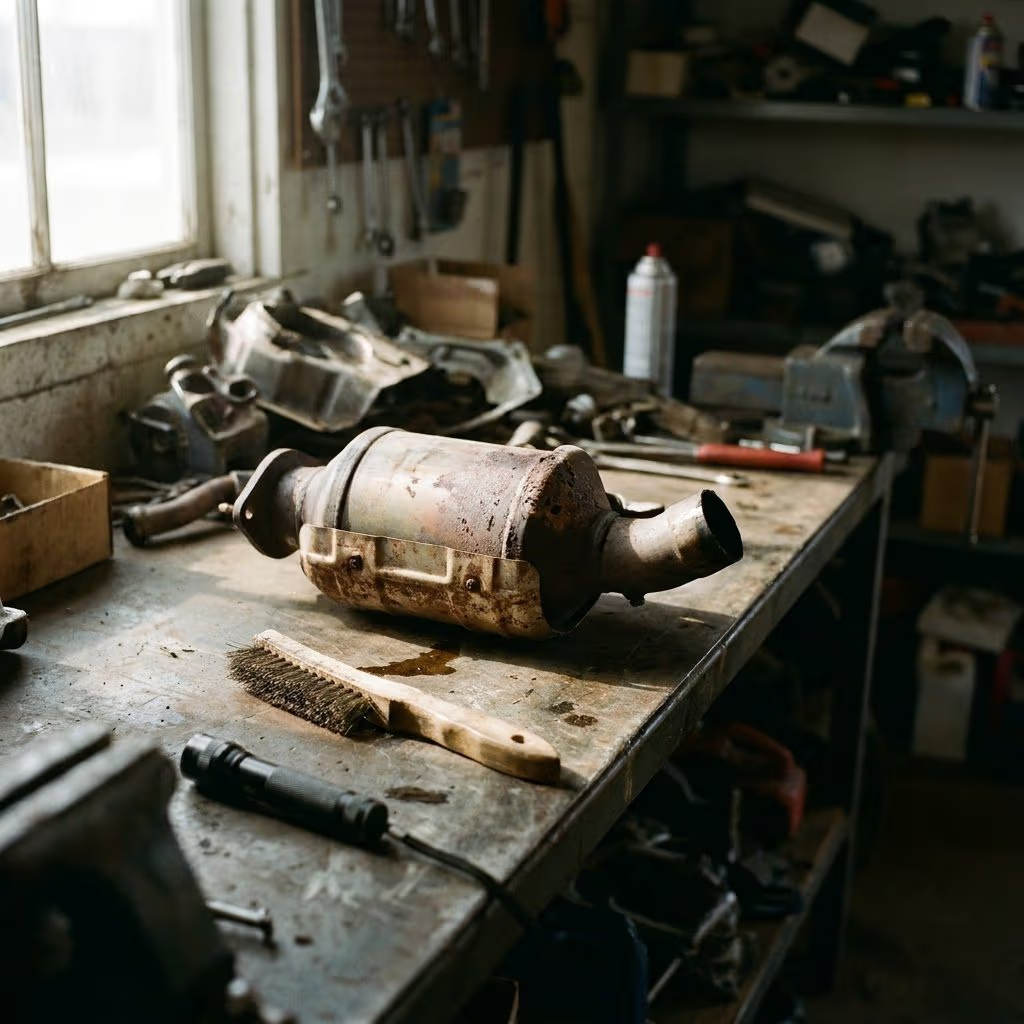
Where is the number on a catalytic converter?
Ecotrade, a converter buyer, says each converter has a reference carved or printed on it. RRCats, Rockaway Recycling's converter-buying site, says some do not.
| Converter | Where to look | What you may see |
|---|---|---|
| GM and Chevy | A corner, the main shield or along the casing | RRCats says these often begin with 126, 127, 253 or 255 |
| Honda | The shield, but do not count on a number | RRCats says most are unmarked and asks for photos of the shield |
| Other factory units | Corners, under shields and on down pipes | A stamped or etched code |
| Aftermarket | The outside of the shell | Rockaway says often a silver plate with an arrow |
An aftermarket number will not get you much. Rockaway posted aftermarket converters at $5 each on November 1, 2026.
A short video from the Rockaway Recycling channel. The title says it shows how to find the serial number on a converter. Rockaway buys converters, so this is a buyer's advice. Published September 2019.
Is it really a serial number?
Not in the sense most people mean. A true serial number belongs to one item. What buyers call the serial number on a converter is usually a manufacturer's part or reference code, and many converters share it. That is why a lookup can work: someone tested a converter with that code, and the result gets applied to the others.
Why do buyers price by that number?
The value is in the platinum, palladium and rhodium inside, and two converters that look alike can hold very different amounts. The code is a shortcut to that metal loading. Converter Database describes its listings as based on XRF values, meaning X-ray tests of metal content. Without a code, a buyer prices by category, and categories are wide. Rockaway Recycling posted these ranges on November 1, 2026, and says prices can change at any time:
| Rockaway's category | Posted range, each |
|---|---|
| Small GM | $18 to $764 |
| High grade domestic | $68 to $612 |
| Large Chrysler | $92 to $279 |
These are one buyer's category ranges, not prices for any serial number. A single category running from $18 to $764 is why the number matters.
How do lookup sites and buyer apps work?
You enter the code, or part of it, and the tool returns a price tied to metal markets. We read these listings on November 1, 2026.
| Type of tool | Example | Cost or account |
|---|---|---|
| Reference database | Converter Database | Has log in and sign up links. The home page does not say what each unlocks |
| Subscription app | Catalytic Converter Guide | Free to download. Plans listed at $19.99 a month or $149.99 a year |
| App with buyer prices | Cat DB | Free plan with 3 code searches a day. Account needed after 30 days. Paid plans from $11.99 a month |
| Buyer's own price book | Ecotrade | You search its buying price once you have an account |
PMR, a company in converter processing and refining, warns that serial number databases can rest on a single analyzed sample, that two converters with the same number can differ a lot, and that a number "cannot guarantee a price." PMR promotes assaying whole lots, so it has a stake here. Prices also move with the metals, so last month's screenshot is not worth much.