Scrap Metal Price Trends 2026: What Is Your Junk Car Worth Today?
Steel, aluminum, and catalytic converter precious metals all move independently — and all affect your junk car payout. This March 2026 market update explains exactly what's driving offers by vehicle class, the stripped-car penalty table, and when waiting for prices to rise actually makes sense.
Article image
🚨 March 2026 Market Pulse
Shredded auto scrap has stabilized after a volatile Q4 2025, holding 8–11% above the 5-year historical average. Platinum and rhodium demand is up 12% on the quarter, boosting catalytic converter values across all vehicle classes. If you've been sitting on a junk car waiting for the right time, this quarter is looking solid.
Updated: March 5, 2026
· By U-Pull-It.com Commodity Analysis Team
When you search "scrap metal prices near me today," you're really asking about three separate commodity markets that all feed into your payout: steel, aluminum, and precious metals. Quotes can vary by $150–$500 on the same vehicle between yards, and it's not random — it reflects each yard's inventory needs, processing capacity, and which commodity market they're most connected to.
This guide breaks down exactly what's driving 2026 prices, what your specific vehicle type is worth, and the decisions you make before calling that directly affect how much you walk away with.
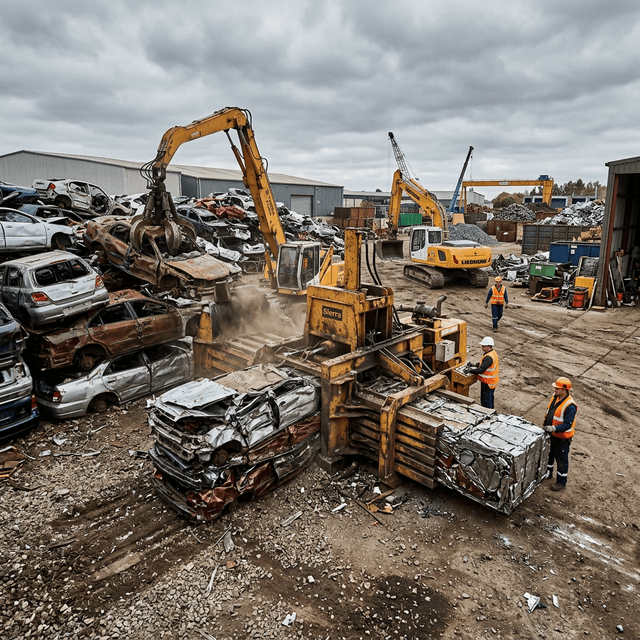
Your junk car is a container of industrial commodities. When a yard quotes you, they're running three calculations and adding them together:
Scrap steel weight × current shred price per ton.
The car body, frame, doors, and engine block are mostly steel. The grade for junk cars is called Shredded Auto Scrap (Number 1 Shreddable). It's priced per gross ton at regional scrap exchanges and changes weekly with global steel demand.
Non-ferrous metal value.
The radiator, AC condenser, and wiring harnesses contain aluminum and copper. These go to different processing streams and are priced separately.
Parts value.
If the yard plans to resell the engine, transmission, or other components rather than crush everything, that factors into the offer. This is why quotes vary: a yard with a buyer for a 2.4L Honda K-series will pay more for your Accord than one that's already full of them.
The catalytic converter doesn't fit neatly into any of these three buckets — it's treated as its own line item because it contains platinum group metals (PGMs), which fluctuate on their own market.
2. Steel, aluminum, and precious metals — 2026 snapshot
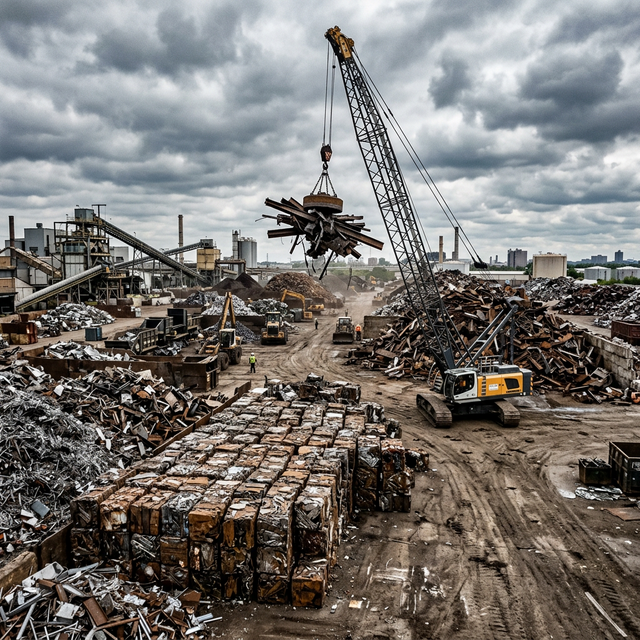
Scrap yards feed electric arc furnace steel mills that use recycled metal instead of virgin iron ore. When steel production rises, scrap prices follow.
Steel: the baseline
Most of your car's weight (60–65%) is steel. Shredded auto scrap prices are currently running 8–11% above the 10-year historical average, driven by electric arc furnace capacity expansion in the US. These mills need scrap because they can't use iron ore directly. More capacity means more demand for shred — a tailwind for sellers right now.
An average passenger sedan weighs about 1.5 tons. At current shred prices, the steel alone accounts for roughly $250–$380 of your payout before any parts or PGM value is added.
Aluminum and copper: the hidden money
Your radiator is aluminum. The wiring harness is copper. Most modern four-cylinder engine blocks are aluminum. These materials are worth more per pound than steel — aluminum runs $0.35–$0.55/lb, copper $3.50–$4.20/lb. For a typical mid-size sedan, non-ferrous metals add $40–$90 to base scrap value. In a diesel pickup with a large aluminum engine block, that's closer to $150.
Precious metals: the catalytic converter story
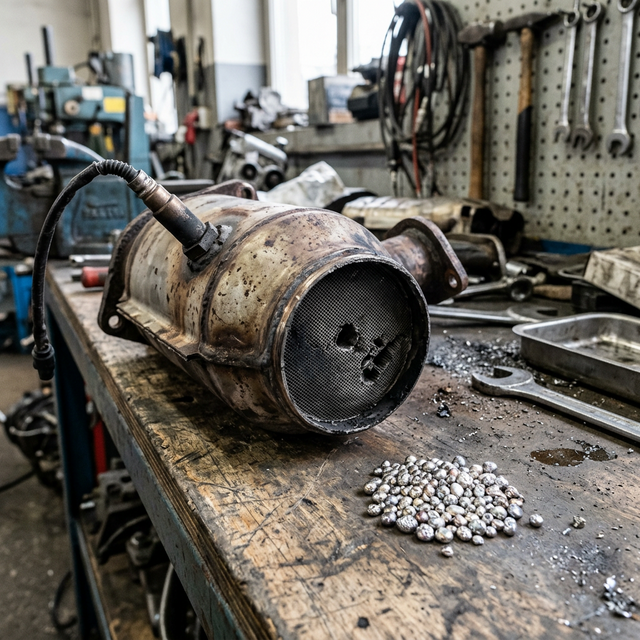
A catalytic converter's ceramic honeycomb is coated with platinum, palladium, and rhodium. The loading varies dramatically by engine size and vehicle age.
Catalytic converters contain small but significant amounts of platinum, palladium, and rhodium — the platinum group metals (PGMs). Their prices are set on a separate commodity market and can swing 20–30% in a quarter. Here's where things stand in March 2026:
Metal
Spot price (approx.)
Trend
Vehicle relevance
Platinum (Pt)
~$990/oz
↑ +7% YTD
Dominant in diesel converters
Palladium (Pd)
~$1,050/oz
↑ +12% QoQ
Dominant in gasoline converters
Rhodium (Rh)
~$4,800/oz
~ Flat
Small amounts, outsized impact on value
An OEM converter on a V6 SUV or truck is worth $400–$1,400 on its own. Economy car converters run $80–$250. Aftermarket converters: $10–$40. Hybrid vehicles have especially large OEM converters and currently sit at the top of the value range.
⚠️ Do not remove the catalytic converter yourself before selling. Beyond the legal risk, DIY removal almost always costs you money. Yards price complete cars — the converter being attached is part of how they calculate a full-car offer. The math almost never works in your favor when you remove it.
3. Payout comparison by vehicle class (2026)
Year-over-year payout changes by vehicle class — March 2026
Heavy steel weight + high-demand OEM drivetrain parts + large converter
$600–$1,200
Full-size SUVs (Tahoe, Expedition, Suburban)
↑ +$80–$100
Similar to trucks; aluminum engine adds in some models
$550–$1,100
Mid-size trucks (Tacoma, Colorado, Frontier)
↑ +$55–$80
Strong used parts demand, especially Toyota platform
$450–$900
Mid-size sedans (Camry, Accord, Altima)
↑ +$40–$65
Strong parts demand, decent scrap weight, good converter value
$350–$750
Economy sedans (Civic, Corolla, Sentra)
↑ +$35–$55
High platform demand for parts; lower scrap weight but consistent
$300–$650
European luxury (BMW, Audi, Mercedes)
↓ -$15–$40
Complex multi-material construction raises dismantling costs
$250–$600
Hybrid battery note: Working hybrid battery packs (Prius, Volt, Insight) have their own recycling market. Functioning packs can add $200–$500 above the converter value. If your hybrid still runs, mention it explicitly when getting quotes.
4. The stripped car penalty: what it costs you
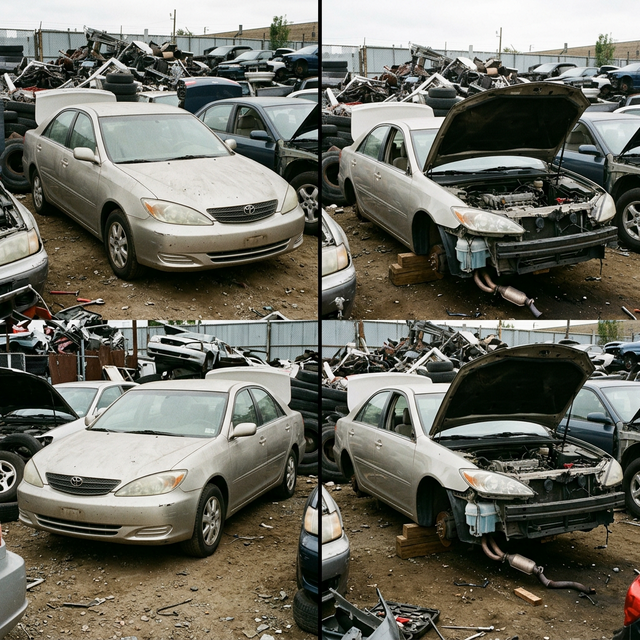
Intact (left) versus stripped (right). The offer difference can be $200–$600 depending on what's missing.
This is the most common way people lose money before they call. The logic seems sound — pull the battery, sell it separately, take the wheels off, remove the stereo. By the time you're done, the car is worth significantly less than if you'd left it alone.
Typical offer reductions for missing components
Component removed
Typical offer reduction
What you'd actually get selling it separately
Catalytic converter
-$150 to -$800
$50–$200 at a converter buyer (vs. $400–$1,400 as part of a complete car)
Battery (12V)
-$20 to -$60
$15–$40 core at AutoZone; $0–$25 at a junk buyer
Wheels/tires set
-$40 to -$120
$80–$300 for alloys in good condition on Craigslist; time-consuming
Radiator
-$20 to -$50
$15–$40 at an aluminum buyer; hard to sell privately
Starter / alternator
-$20 to -$45
$25–$60 at a core buyer; multiple trips required
The pattern: what you gain selling separately is almost always less than what you lose on the junk car offer — and you've added hours of work. The catalytic converter is the clearest example: a converter buyer pays you a fraction of its PGM value because they need margin too. The yard, pricing you as a complete car, captures less of your value.
Find out what your car is worth right now
We price by year, make, model, mileage, and condition — not just by weight.
Run through these five steps before you dial your first yard. Each one takes minutes and the combined effect can swing your offer by $200–$500.
Know your car's weight class. A full-size truck at 5,500 lbs has roughly 3× the scrap steel of a compact sedan at 2,800 lbs. If you have a truck, that's in your favor right now — lead with that.
Get at least three quotes, minimum. Yards have different inventory mixes. A yard short on late-model F-150 engines will pay $200 more for your truck than one down the road with five of them. You won't know which is which without calling both.
Confirm whether the car runs and moves. Running vehicles consistently get $100–$250 more than non-running ones because more dismantling options are available. If your car starts and moves, say so clearly on every call.
Have your title ready before you call. A clear title means same-day processing. Many yards offer a small premium for hassle-free transactions. If the title is lost, apply for a VTR-34 duplicate first — the no-title guide has state-specific steps.
Sell before it sits another month. Every month of outdoor storage is gradual value destruction. Seals dry out, interior mold develops, and — most critically — the catalytic converter becomes a visible theft target worth $200–$1,400 to a thief.
6. Should you wait for scrap prices to rise?
For almost everyone, no.
Monthly price swings in shredded auto scrap average $10–$25 per ton. On a 1.5-ton sedan, that's $15–$37 per month in upside — best case. A catalytic converter theft costs $200–$1,400 in a single night. Rodent damage to wiring runs $400–$800 if you were ever going to fix the car. The "wait for prices" math doesn't work for one car in a driveway.
The one exception: If PGMs have just spiked dramatically and your car has a very large OEM converter (V8 truck, luxury SUV), a 30-day hold might net $50–$100 extra. But that requires actually tracking the spot price — and in that same 30 days, the converter theft risk wipes out the potential gain for most outdoor storage situations.
Why are scrap metal prices so different between yards?
Different yards have different inventory needs. A yard short on Honda Civics will pay more for yours than one with twenty already. Yards also use different pricing models — some pay straight scrap weight, others value usable parts separately. Three quotes in 20 minutes reveals the real ceiling for your vehicle.
What is shredded auto scrap and how does it affect my payout?
Shredded auto scrap (Number 1 Shreddable Scrap) is the industry category for junk cars processed through a shredder. It's priced per gross ton at regional scrap exchanges and moves with global steel demand. In 2026, electric arc furnace steel production — which relies on recycled scrap — is keeping shred prices above historical averages, supporting stronger payouts.
How much is a catalytic converter worth for scrap in 2026?
OEM converters contain platinum, palladium, and rhodium. Depending on the vehicle and current precious metal prices, a single OEM converter is worth $80–$1,400. Truck and V6/V8 converters have more precious metal loading. Aftermarket converters are worth $10–$40 because they contain far less PGM material. This is exactly why converter theft has spiked — these values are real.
Is it better to scrap my car or sell it for parts?
For most people, a straight scrap sale is the right call. Parting out requires tools, storage, 4–8 months of time, and knowledge of which parts sell. Most DIY part-outs return only marginally more than a junk sale. The exception: high-demand engines, rare manual transmissions, or trim that collectors actively search for — then parting out can return 2–3x the scrap price. But only with the right setup to pull it off.
Should I wait for scrap prices to go up before selling?
Almost never. Monthly scrap price swings translate to $15–$40 on a typical car. A stolen catalytic converter reduces your payout by $200–$1,400 overnight. Market timing works for commodity traders with warehouses — not for one car sitting outside.
Which vehicle types bring the most money in scrap in 2026?
Hybrids top the list — battery pack value plus large OEM converters. Full-size trucks rank second: heavy steel, high-demand parts, large converters. Economy sedans rank third. European luxury vehicles rank lower because complex disassembly increases yard labor costs, and that cost comes directly off your offer.
About this guide: Written by the U-Pull-It.com Editorial Team — a group of salvage industry professionals with 20+ years of combined experience in auto recycling, scrap commodity markets, and self-service junkyard operations across the United States. Precious metal prices and scrap steel commodity data referenced from public market sources as of March 2026. Actual payout offers will vary based on vehicle condition, local market conditions, and current commodity spot prices at the time of transaction. U-Pull-It is a licensed salvage and recycling facility.