The Sister Car Secret: How to Find Interchangeable Auto Parts at the Junkyard
Your Toyota Corolla and a Pontiac Vibe share nearly every mechanical part. Here's the master platform interchange matrix, the 3 things you must verify before you pull, and how to use Hollander Numbers to find parts nobody else knows exist.
Article image
Published: March 4, 2025
·
Updated: March 4, 2025
· By U-Pull-It Technical Team
Auto parts are interchangeable between "sister cars" - different vehicles built on the same chassis platform - and knowing which ones share parts can triple your donor pool at any junkyard.
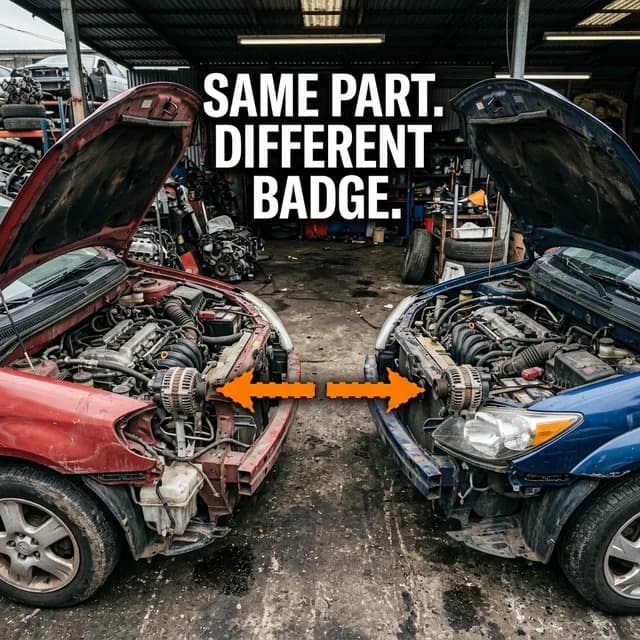
Here's the situation every junkyard regular has faced: you need an alternator for your 2006 Toyota Corolla. You walk the lot. Every Corolla is stripped. But there are four Pontiac Vibes in Row C that nobody has touched. Here's the thing nobody tells new visitors: the Vibe is a Corolla underneath. Toyota built it for GM under a joint venture. Pull the alternator from any of those Vibes and it bolts right in.
That's platform interchange in practice. This guide gives you the master compatibility matrix plus the three checks that prevent you from pulling the wrong part.
Key Terms
Platform sharing
When multiple vehicle models are built on the same underlying chassis, suspension, and engine architecture. Creates a large interchange parts pool for DIYers.
Hollander Number
Industry-standard identifier for a group of interchangeable parts. Same Hollander Number = confirmed fit, regardless of make or model. Used by every major salvage yard in North America.
8th VIN digit (engine code)
The 8th character of your 17-digit VIN identifies the specific engine family. Critical to match for engine-specific components like sensors, coils, and fuel injectors.
Interchange group
All vehicles confirmed to share a given part under the Hollander system. Knowing your group multiplies the number of donor vehicles you can pull from.
Why do different car brands share the same parts?
Automakers use platform sharing to cut R&D and manufacturing costs. They design one chassis, suspension, and powertrain family - then build five different-looking cars on top of it. For the automaker, it's a cost strategy. For a DIYer at a junkyard, it's a secret weapon.
Professional recyclers call these "Interchangeable Groups" and they search across the entire group, not just your specific model. You should too.
Find your interchange group fast: Go to Car-Part.com, search your part, and click "Interchange." It expands your search across every confirmed donor vehicle automatically, showing real inventory at yards nearby.
The master part compatibility matrix
Top platform interchange groups - most commonly found at U-Pull-It yards
Your Vehicle
"Sister" Models (Donors)
Commonly Shared Parts
Toyota Corolla (2003-2008)
Pontiac Vibe, Toyota Matrix
1ZZ-FE engine, alternator, starter, coil packs, front suspension arms, power steering pump
Honda Accord 2.4L (2003-2012)
Acura TSX (2004-2014), Honda CR-V (2002-2011), Honda Element (2003-2011)
What must I verify before pulling an interchange part?
Platform sharing does not guarantee every part crosses over. Luxury trim levels, build years, and option packages create sub-variants. Check these three things before pulling:
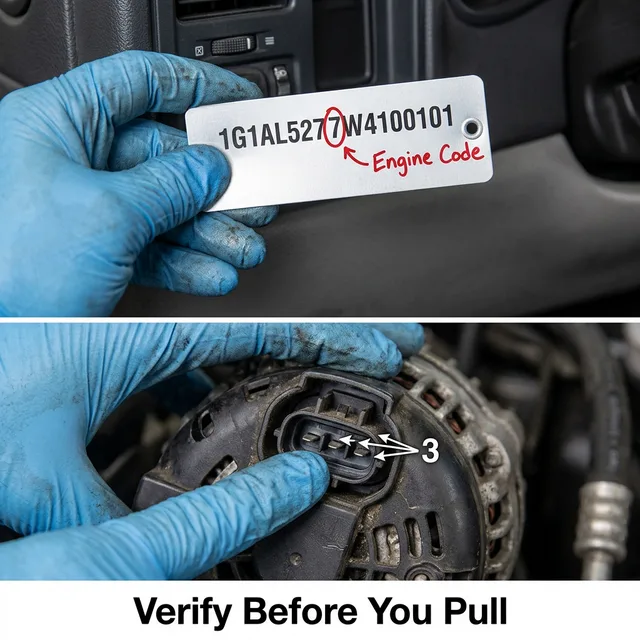
Before you pull: verify the engine code (8th VIN digit) and connector pin count. These two checks catch 95%+ of interchange mismatches.
The 8th VIN digit (engine code).
For engines and engine-specific components (sensors, coils, injectors, intake manifolds), the 8th character must match. A "K" and an "L" code engine look identical externally but sensors won't plug in. Read the VIN through the windshield from outside the car.
Electrical connector pin count.
Count the pins on the connector before you pull. Luxury trims often use higher-output alternators with different connectors. A 3-pin and 4-pin alternator plug are not interchangeable. Takes 30 seconds.
The Hollander Number.
Ask the yard clerk: "What's the Hollander Number for this part?" If two parts share the same Hollander Number, they are guaranteed to fit regardless of brand. You can also look up numbers on Car-Part.com before your visit.
At the counter: Write the Hollander Number on your hand or save it to your phone. Give it to the clerk and ask them to "search the Hollander interchange" - they can check across all donor vehicles in the system, including sister locations, in seconds.
How to get the best price on interchange parts
Knowing the interchange group also gives you price leverage. If a yard prices a Corolla alternator at $180 but Vibe alternators are $60 because nobody pulls them, you saved $120 for the exact same part. At the counter:
Bundle related parts.
Pull the alternator, serpentine belt tensioner, and related hardware together and ask for a flat bundle price at checkout. Yards prefer one transaction over three.
Point out cosmetic defects.
A visible scratch on a bracket or minor crack on a non-structural piece? Mention it at checkout: "This has a cracked bracket - can you do 15% off?" Most yards will.
Know market price first.
Check Car-Part.com for going rates at other yards and eBay sold listings before arriving. That's your negotiating range. If the yard is at the ceiling, you have a real counter-offer.
Ask for a 30-day warranty in writing.
Full-service yards often provide it if asked - it's rarely volunteered. For U-Pull yards, ask about their return policy before you pull.
Real example: A K24 alternator pulled from a Honda Accord at a U-Pull yard typically runs $40-$65. The same part positioned as "Acura TSX alternator" at a full-service dealer-adjacent yard can be $180-$220. Same casting number, same Hollander Number, same part. Knowing the interchange earns you $120+ on a single pull.
Reading the donor vehicle before you pull
Learn to read why a car is in the yard - it tells you how good its parts are. Rear-end collision only = engine, transmission, and front suspension were likely fine at the time of impact. Clean interior, clear oil on the dipstick, service stickers on the valve cover = well-maintained car. Flood line on door trim or musty smell = avoid all electrical components - they will corrode from inside out within a year.
See our full junkyard tools guide for a complete pre-pull inspection checklist and what to bring to the yard.
Frequently asked questions: part interchange
What cars have interchangeable parts?
Any cars built on the same platform share most mechanical components. Key groups: Toyota Corolla/Matrix/Pontiac Vibe (MC platform); Honda Accord 2.4L/Acura TSX/CR-V/Element (K24 family); Chevy Impala/Buick Regal/Pontiac Grand Prix/Olds Intrigue (W-Body); Ford Fusion/Mercury Milan/Lincoln MKZ/Mazda 6 (CD3 platform); VW Golf/Jetta/Audi A3/Tiguan (PQ35/MQB). The full interchange database is at Car-Part.com.
What is a Hollander Number and how do I use it?
A Hollander Number is the industry-standard identifier for an interchange group - all parts that share the same number are confirmed compatible. Look it up on Car-Part.com or ask the yard clerk. When you give a clerk a Hollander Number, they can search across all vehicles in their system instantly instead of guessing by make/model.
Can I put a Chevy part on a GMC?
Yes, almost always. GM owns both brands and shares approximately 95% of components across Chevy and GMC trucks and SUVs. A Silverado and a Sierra are mechanically identical for most model years. The same applies to Chevy Tahoe and GMC Yukon, and most Suburban variants.
Are Acura parts the same as Honda parts?
Many are. The Acura TSX 2.4L (2004-2014) and Honda Accord 2.4L (2003-2012) share the K24 engine, alternator, starter, power steering pump, and many sensors. Acura trims sometimes use higher-output alternators - verify the pin count and amperage rating before pulling.
How do I verify an interchange part will fit before I pull it?
Three checks: (1) 8th VIN digit matches the engine code. (2) Connector pin count is identical. (3) Hollander Number is the same. These catch 95%+ of mismatches. The Hollander check is definitive - if the numbers match, the part fits.
Does color matter for body panels?
Mechanically no - fitment is determined by year and trim, not color. A 2005 Camry door fits any 2005 Camry. But paint codes vary within the same model year. If you want to avoid repainting, check the paint code on your door jamb sticker and match it to the donor car's sticker.
About this guide: Written by the U-Pull-It technical team based on hands-on experience with the Hollander interchange system across our Florida junkyard locations. U-Pull-It is a licensed salvage facility operating full-service and self-service yards.